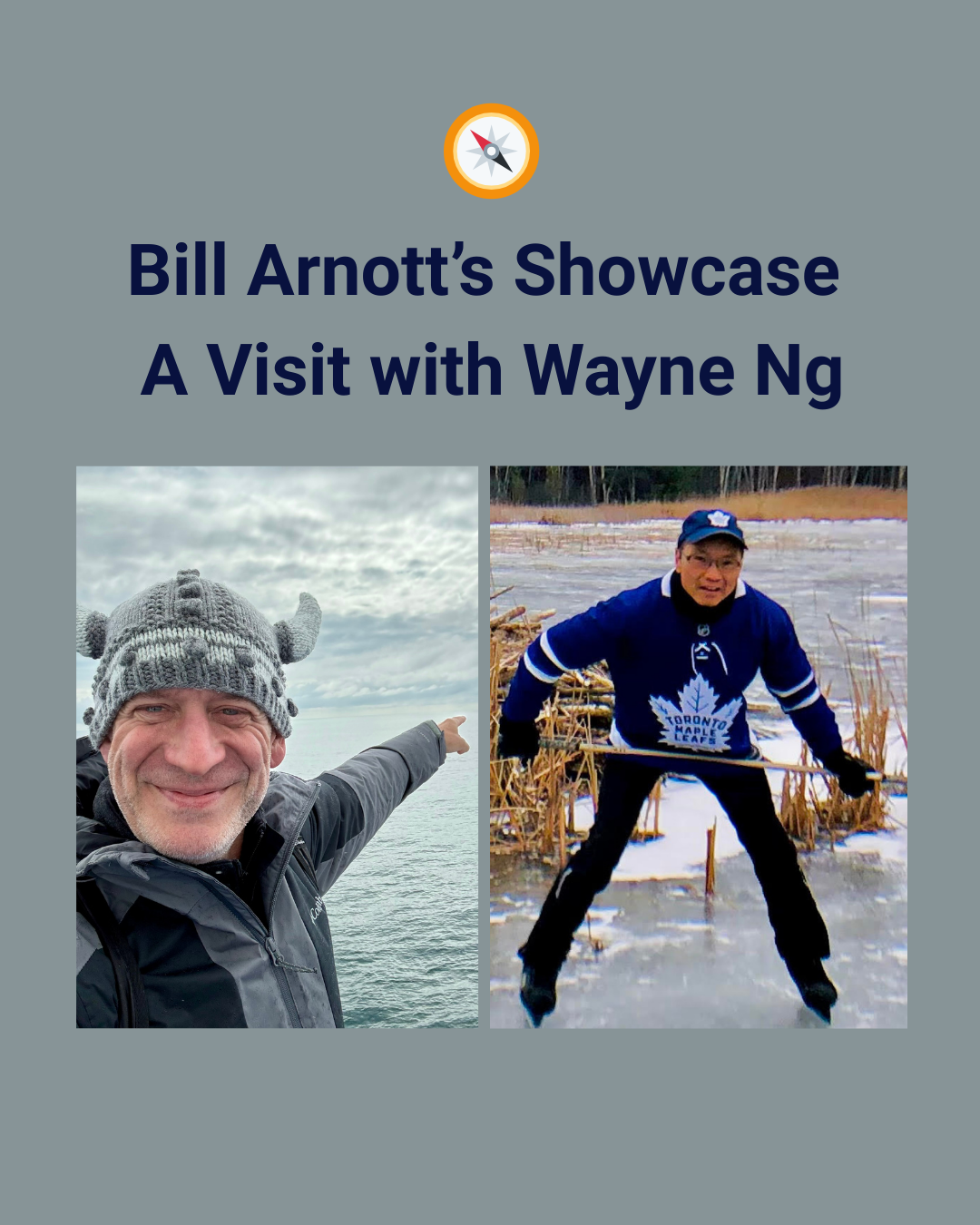
Wayne had a great conversation with bestselling author Bill Arnott and was honoured to be featured in his Showcase.
🧭Bill Arnott is the bestselling author of A Perfect Day for a Walk, A Perfect Day for a Walk by the Water, the Gone Viking travelogues and Season memoirs, award-winning titles that are among BC’s top-selling books.
Read the interview below, reproduced from Bill Arnott’s Showcase.
Bill Arnott’s Showcase February 2026
A Visit with Wayne Ng: The Author with a Passion for Bruce Lee & Hockey
Hi Showcasers, and happy 2026! This time I’m delighted to feature award-winning author Wayne Ng, a Canadian powerhouse from Ottawa. I met Wayne through the Writers Union of Canada when he hosted an event I took part in, and I realized this was a writer I could learn from, and more importantly, be friends with. Soon after that Wayne travelled to Vancouver for a writer’s residency at Historic Joy Kogawa House, the childhood home of acclaimed author Joy Kogawa.
Wayne and I connected for coffee, then a social gathering with other writers, and then, with Wayne’s wife Trish and my wife Deb, the four of us had dinner. It happened to be Wayne’s birthday so the evening was not only fun but celebratory as well. During this time, I’ve been enjoying Wayne’s acclaimed novels: The Family Code, Letters from Johnny, and Johnny Delivers.
Wayne’s a great traveller too, having done writing residencies around the world. In fact, to reconnect for the Showcase, I had to wait for Wayne to return from a trek in Nepal. It was worth the wait, as you’ll see. Now, please join us as I visit with Wayne…
Hi Wayne, welcome to the Showcase, and congrats on your continued success with your most recent, Johnny Delivers, the follow-up to your very popular Letters from Johnny. Let’s start at the beginning of your author journey. What inspired you to start writing?
(Wayne) Thanks Bill. I started writing because I’ve always been drawn to story—the power it has to make sense of the chaos around us. Growing up as the child of immigrants, I often felt like I lived between worlds. Writing became a way to bridge that gap, to see myself reflected when I rarely did elsewhere. Later, as a social worker, I was surrounded by lives in transition, trauma, humour, and hope. Storytelling became a natural extension of that work. In the end, I write to understand people, to understand myself, and to add my small voice to the larger conversation about who we are, where we belong and who we might become.
(Bill) I can see that experience, those insights, reflected in your storytelling. So what specifically prompted you to create your “Johnny” books: Letters from Johnny and Johnny Delivers?
(Wayne) Johnny came from a very personal place—my childhood in Toronto’s Chinatown in the ’70s and the tension between wanting to belong and knowing you don’t quite fit. Letters from Johnny started as a nostalgic experiment, a way to revisit those years with humour and hindsight. But the more I wrote, the more I realized Johnny was giving voice to things I’d been carrying for decades: racism, shame, toxic masculinity, silence, and the longing to be seen. Johnny Delivers let me take that further, exploring how a young Asian boy navigates a landscape that constantly misunderstands him, and how the spirit of Bruce Lee—my childhood hero—helped shape the boy and the man he becomes.
(Bill) What was that process like?
(Wayne) Equal parts agony and joy. I had to confront memories I’d rather have left in the attic, but doing so allowed humour and tenderness to rise to the surface. I wanted to avoid the usual immigrant tropes and instead lean into satire, compassion, and the messy imperfections of real life. Both books came in waves: long stretches of grinding doubt, punctuated by moments when Johnny’s voice took over and all I had to do was keep up. That’s when writing feels like magic.
(Bill) That sounds cathartic, and I love the comparison to magic. Where were you when you wrote them?
(Wayne) Mostly at my kitchen table and backyard in Ottawa with too much tea and not enough discipline. Sometimes in cafés, where the noise reminded me that the world keeps moving even when I’m stuck. Occasionally in Toronto, where simply walking the old neighbourhoods stirred up the sensory memories I needed—roast duck hanging in windows, the clang of streetcars, the familiar ache of being home and not-home at the same time.
(Bill) Strong visuals to be sure, utterly connective and engaging. So tell us, please, do you have any other messages or personal stories you’d like to convey to readers?
(Wayne) If there’s a message in the Johnny books, it’s that identity is complicated, grief and shame leave long shadows, and humour can be a survival skill. I hope readers—especially those who grew up straddling cultures—feel a little less alone. I also want people to understand that the stories of Chinese Canadians aren’t footnotes; they’re part of the fabric of this place. Writing these books helped me reclaim parts of myself I didn’t even know I had lost. If they help others do the same, then that’s more than I ever expected.
(Bill) I feel you’ve accomplished that, and then some. Kudos my friend.
(Wayne) Thanks Bill.
(Bill) You can learn more about Wayne and find direct links to his website and books by clicking on his book titles above, the pictures below, or right here.~~~~


Clockwise from upper left: Wayne with Letters from Johnny and Johnny Delivers, Wayne with Bruce Lee on a bicep, Wayne in Nepal, and Wayne on the ice near his home.
Many thanks to Bill Arnott for this spotlight.